By Victor DeTroy
If we consider Benjamin Franklin’s pithy quote “guests, like fish, begin to smell after three days” in light of the PFOA/PFOS CERCLA designation, PFAS are really starting to reek. The new PFAS reality is here, and it smells horrible.
How are we supposed to live in this new reality without making the entire CRE industry turn into pickled herring? Are we really going to have to drill and sample every single site that maybe used PFAS at one point in time? Is the once booming investment in the industrial sector going to instantly dry up? Will we never be able to lend on car washes again?
Have no fear, there is a solution. Time to swallow the red pill and enter the Matrix… the Risk Matrix that is.
PFAS Risk Matrices
The purpose of developing a risk matrix is to help provide a consistent approach for a bank’s ERM team. The hope is that the matrix will help the ERM team comply with the bank’s internal risk appetite.
Let’s start with this general PFAS risk matrix for any type of property use:
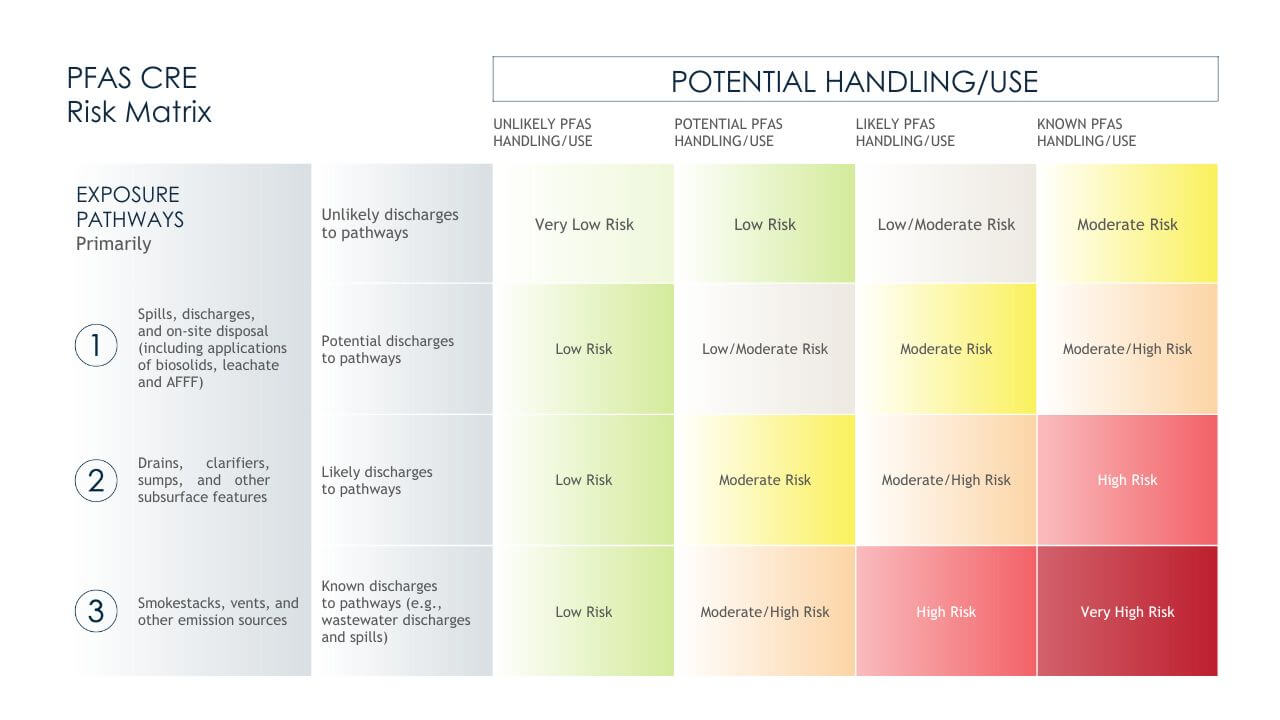
The main factors that go into determining the risk are:
- How likely is it that PFAS were used/handled at the site
- How likely is it that releases could have occurred at the site.
Essentially this matrix aims at determining how likely it is that a release of PFAS occurred at your site.
The main three categories of risk are Low, Moderate, and High, with shades in between. Below is an example ERM risk appetite approach using this matrix:
- Low Risk — A Phase Il is not necessary
- Moderate Risk – Generally a Phase Il is not necessary; however, this may be reviewed on a case-by-case basis
- High Risk – A Phase Il or other mitigation measure (e.g., insurance) is required
This is by no means the only approach. One ERM team may decide that any risk rated “Moderate” or higher will require sampling, while another group may determine that they will only consider (not require) a Phase II for “Very High Risk
Let’s look at an example site to see how this risk matrix works in action.
Example 1 – Print Dudes
- 2,000 SF print shop
- Operational from 1990-2005
- No drains, sumps, clarifiers or any subsurface conduits
- Listed on the federal EPA ECHO database as a facility that likely handles PFAS (based on the provided NACIS code of the business)
Conclusion: Low to Low/Moderate Risk

- PFAS Handling: Since the site was listed on the EPA ECHO database as a likely handler of PFAS it may be considered “likely” that PFAS were used/handled. However, there is no other evidence that PFAS were used, so the argument can be made that PFAS use is “potential” not “likely.”
- Exposure Pathways: However, there are no exposure pathways that would have resulted in a likely release to the subsurface. Therefore, a release is considered unlikely.
Example 2 – Print Czar
- 100,000 SF industrial printing facility
- Operational from 1955-1989
- Several floor drains within the facility (lead to sump and clarifiers)
- Two clarifiers and one sump
- NPDES records identify large-scale industrial wastewater discharges leading to an on-site dry well
- NOT listed on the EPA ECHO database as a likely handler of PFAS
- Known release of solvents did not include analysis of target PFAS
Conclusion: High Risk
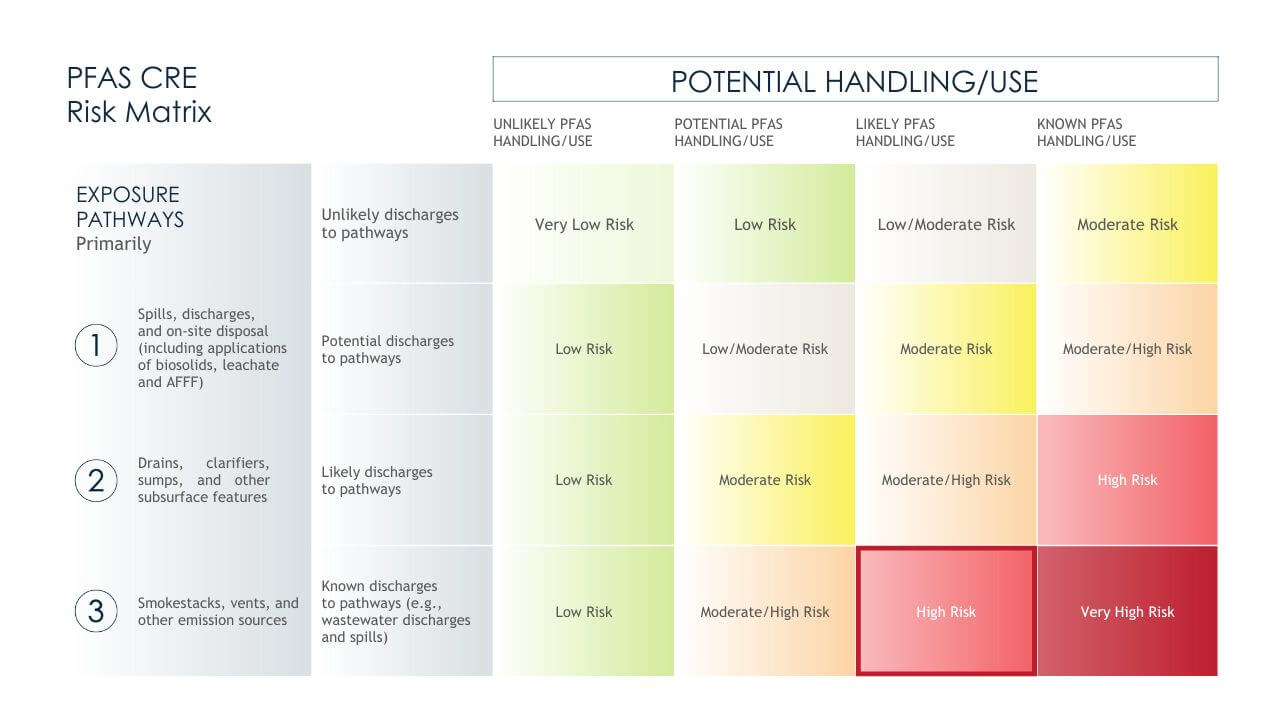
- PFAS Handling: Although the site is not listed on the EPA ECHO database as a facility that likely handled PFAS, it should be noted that this database is based on available NAICS codes provided to the EPA. This is more accurate for current and recent tenants and appears to fall off a steep cliff when dealing with older historical tenants. Based on the nature of site operations and a review of the industrial printing process, it is considered likely that PFAS were utilized by this former facility.
- Exposure Pathways: Given the floor drains, sump, and clarifiers that ultimately drain to the on-site dry well, PFAS contamination is considered likely.
Industry-Specific Risk Matrices
Using this risk matrix methodology, you can also break this down using various industry specific factors. Let’s use car washes as an example.
To date, there are not a ton of studies that have really delved into the likelihood that car washes are the source of PFAS contamination. Of those present, the information is conflicting. A study conducted in New York conducted soil sampling at various potential sources of PFAS including a car wash. One sample collected on the car wash showed a concentration of PFOS in soil at 11 ppb, however, the NYSDEC concluded that this was not significant, and the car wash was not considered a source of PFAS contamination in the area.
A separate study conducted in northern California found that PFAS were present in the wastewater effluent (at higher concentrations then the influent) from the three different car washes that were sampled. Total Oxidizable Precursors (TOP) measured at car washes were higher than those measured at other industrial sites (including a paper mill, semiconductor manufacturer, and a hard chrome plating facility). However, target PFAS such as PFOA and PFOS were relatively lower in comparison.
Furthermore, no extremely high values were detected at the car washes and the general discharge flow rates were identified to be lower than other sources such as an industrial laundry. Additionally, since only influent and effluent were sampled, it is unclear how often car wash operations actually resulted in a release to the subsurface.
How are PFAS Used In Car Wash Operations?
PFAS are used in car wash operations for their water-repellent properties. Some car washes utilize PFAS-containing products because they repel water, oil and dirt. Car washes use PFAS in various forms, such as sprays, waxes, coatings and rinses. These products are applied to vehicles to create a barrier that prevents the buildup of water, oil, and dirt. In particular, vehicle spray on waxes and coatings containing PFTE (i.e. Teflon) or similar spray on waxes/coatings containing PFAS are considered a likely source of PFAS at car washes.
In 1989, Turtle Wax was first identified in newspaper advertisements as the “only wax with Teflon.” By the early to mid-1990s, several other firms developed waxes and coatings for car washes that contained PFAS. By circa 2010, car waxes containing “Teflon” were gradually phased out of the marketplace. Therefore, car washes that operated from 1989 to 2010 are considered to have the highest risk of potential PFAS contamination.
The other major concern for car washes is if they drain directly to a municipal source or to an on-site dry well, septic system or any other type of injection well.
Using these factors, a risk matrix can be tailored for PFAS at car washes:

Let’s say you have a car wash that has operated since 2010. Oh no, is this an automatic REC and Phase II? Not necessarily. Looking at the risk matrix, we can see that this would fall into the “short term use” category since it only operated during the period of concern for a short period of time (2005-2010). If you are able to review current Safety Data Sheets (there are no PFAS identified) and according to an interview with the owner, the waxes used on site have been the same since 2005, potential PFAS uses seem even less likely. If you also factor in the fact that the site is connected to a city sewer system, you can ultimately conclude that you have a low risk of PFAS contamination on your hands.
Final Thoughts
We’re glad you took the red pill and went down the PFAS risk rabbit hole with us. As more studies are published, we will be able to refine the risk even more. The hope is to whittle the giant amorphous PFAS monster risk down so that it fits into a manageable enclosure.
Checkout Similar Blogs:
- Exploring the Physical Risk Component of the SEC’s Climate Disclosure Rules
- EPA Classifies PFOA & PFOS As Hazardous Substances
- WOTUS Rule Revision Simplified
- The Latest Updates to ASTM Standard E2018-24 for PCAs
- Property Insurance Coverage: Positioning Assets
- ESG Checklists On The Rise
Most Sought Out Services:
Environmental Consulting, Building Assessments, Capital Planning, Construction Risk Management, Environmental Health, Safety & Compliance, Industrial Hygiene, Land Surveying and Mapping, Site Mitigation, Energy & Sustainability Consulting, Zoning Services, Commercial Valuation Services
Popular Markets:
Brownfields, Data Centers, Education, Agency Services, Government & Infrastructure, Hospitality, Industrial, Mixed-Use, Oil & Gas, Recreation, Retail, Telecommunications, Corporate Real Estate, Development/Redevelopment, Facilities, Financial Institutions, Healthcare, Housing & Urban Development (HUD), Legal, Office, REITS, Renewable Energy, Small Business Administration (SBA)