
Mark your calendar! The 2026 ALTA/NSPS Standards officially launch on February 23, 2026.
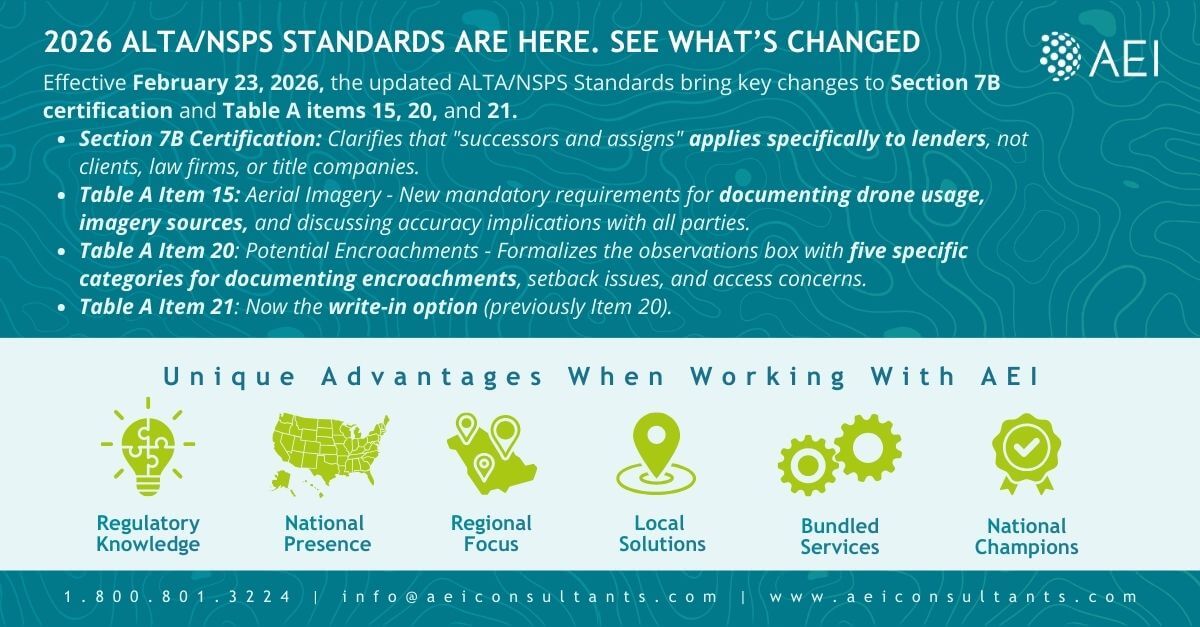
Most of the 2026 ALTA/NSPS Standards involve minor changes focused on simplifying and adding clarity to the Standards. Below are some key changes:
Section 7 Certification: New Subcategory Added
An important addition to the Standards is found in Section 7 Certification, where subcategories have been added. Section 7B now exists and is intended for scenarios where “certification may be extended to successors and assigns of the lender if requested.” NOTICE the wording: “…OF THE LENDER…”, the intent is clear this applies specifically to the lender, not to the client, buyer-created entities, law firms, and certainly not the title company.
What will likely happen over the next five years: Since this is not ironclad wording (i.e., “…may be extended…” rather than “…may ONLY be extended…”), this section will likely be ignored by the client teams who will continue to request or demand “successors and assigns” to any entity type.
Table A Updates (Items 15, 20, and 21)
Table A Item 15 has been reworded, reformatted, and clarified to better instruct land surveyors on what to perform. In short, this is the Optional item to select when aerial imagery, photography, drones, etc., are being used to capture features and improvements. There are now three mandatory subcategories that MUST be followed:
(a) Agree with the client in writing on imagery to utilize, including source, date and/or version of imagery, and licensing costs and requirements,
(b) Discuss the ramifications of such practices (e.g., the potential accuracy, precision and completeness of the imagery gathered thereby) with the insurer, lender, and client prior to the performance of the survey, and
(c) Place a note on the face of the survey explaining the source, date, precision, and other relevant qualifications of any such imagery.
Table A Item 20 is no longer the write-in Option. The write-in option is the new Item 21.
Newly created Item 20 is designed for the “Potential Encroachments” box. At AEI, we have been calling this the “Significant Observation” box for several years. This Item 20 will be checked/selected by every lender, and since most land surveyors have been adding this box on their ALTA/NSPS Surveys, this is not a surprising addition to the Table A options.
Why was it added? To give land surveyors clarity on how to state potential issues. There are now five bullet points instructing land surveyors what and how to state potential issues, along with preamble disclaimer text for the land surveyors to add to this new box:
“When observed in the process of conducting the fieldwork or otherwise identified in the process of preparing the survey the following conditions and potential encroachments must be summarized in a table and indicated on the face of the plat or map. Without expressing a statement of legal opinion or an opinion as to ownership, the table must identify the physical conditions, and provide a means by which the conditions can be readily located on the face of the plat or map by a reviewer; however, this table may not be a comprehensive list of all concerns shown on the plat or map of the survey.”
- Potential encroachments over boundary lines onto the surveyed property from adjoining property and onto adjoining property from the surveyed property.
- Potential encroachments into rights of way and easements for which written documentation of the existence of such rights of way and easements was provided to or obtained by the surveyor pursuant to Section 4.
- Potential encroachments of front, side or rear setbacks, but only when the setback requirements specific to the surveyed property were provided to the surveyor pursuant to Table A item 6(a) or 6(b) or provided in recorded documents.
- Physical access between adjoining parcels without benefit of an easement for which written documentation of the existence of such easement was provided to or obtained by the surveyor pursuant to Section 4.
- Use of adjoining parcels by apparent occupants of the surveyed property without benefit of an easement for which written documentation of the existence of such easement was provided to or obtained by the surveyor pursuant to Section 4.
Frequently Asked Questions
To help clarify the 2026 Standards, ALTA/NSPS has released additional guidance addressing common questions and transition scenarios. We’ve highlighted a few key FAQs below, but you can access the complete document for detailed answers.
What about the transition period leading up to and immediately after February 23, 2026?
If a contract to perform a Land Title Survey is executed on or after February 23, 2026, the survey must be performed pursuant to the 2026 Standards, with a couple of possible exceptions explained below.
During the transition period, surveyors may encounter situations whereby they have entered into a contract to perform an ALTA/NSPS Land Title Survey prior to the effective date of the 2026 Standards (February 23, 2026), but the survey is not anticipated to be completed until after February 23, 2026. In such cases, the surveyor may discuss this with the client, title company and lender and include an appropriate clause in the contract as needed, viz., “This survey will be prepared using the 2021 Minimum Standard Detail Requirements for Land Title Surveys as established by ALTA and NSPS since said standards are still currently in effect at the time of this contract. It is understood and accepted by all parties involved that said standards may no longer be current upon completion of the survey, but will still be used for the purpose of this survey.”
Is the surveyor responsible for showing underground easements?
No, not unless information is provided on an underground easement. Otherwise, the standards merely require that the surveyor note observed evidence of potential underground easements.
What constitutes “other title evidence”? Why not simply require a title commitment?
Starting in 2016, the ALTA/NSPS Standards stated that the surveyor needs to be provided with the most recent title commitment or “other title evidence satisfactory to the title insurer.”
Title companies have other products that are sometimes requested by clients that are short of title commitments and policies, but that – for a variety of reasons – are acceptable to clients in some circumstances.
In some cases, even though a title company may be involved, a title policy may not be issued as a part of the transaction. For example, some governmental agencies do not buy title insurance – they self-insure – but they may obtain an “owner and encumbrance report” from the title company.
Also, the U.S. Department of Housing and Urban Development may or may not require title insurance; in some cases, an attorney’s title opinion may be acceptable (which could be based on, for example, an abstract of title).
Moving Forward with the 2026 ALTA/NSPS Standards
While the 2026 ALTA/NSPS Standards may not represent a major overhaul, the updates to Section 7B certification and Table A items 15, 20, and 21 carry significant implications for lenders, title companies, and surveyors alike. The clarification in Section 7B regarding “successors and assigns of the lender” sets a clear intent, though we anticipate ongoing challenges as the industry adapts to this nuanced language over the coming years.
The formalization of Table A Item 20 for potential encroachments is a welcome addition that aligns with best practices many surveyors, including our team at AEI, have already implemented. Combined with the enhanced requirements for aerial imagery documentation in Item 15, these updates underscore the industry’s continued push toward greater transparency and precision in land surveying.
At AEI Consultants, staying ahead of industry standards isn’t just part of our business; it’s core to who we are. As back-to-back national ALTA/NSPS competition winners (1st place in 2025, 2nd place in 2024), we bring both technical excellence and practical expertise to every survey we deliver. Our local knowledge and national presence mean we understand these standards inside and out, across all property types: commercial, multifamily, industrial, retail, office, hospitality, you name it.
As these 2026 standards take effect on February 23, 2026, our team is ready to help you navigate the changes and ensure your surveys meet the highest industry standards. Have questions about how these updates impact your projects? Contact us.
Most Sought Out Services:
Environmental Consulting, Building Assessments, Capital Planning, Construction Risk Management, Environmental Health, Safety & Compliance, Industrial Hygiene, Land Surveying and Mapping, Site Mitigation, Energy & Sustainability Consulting, Zoning Services, Commercial Valuation Services
Popular Markets:
Brownfields, Data Centers, Education, Agency Services, Government & Infrastructure, Hospitality, Industrial, Mixed-Use, Oil & Gas, Recreation, Retail, Telecommunications, Corporate Real Estate, Development/Redevelopment, Facilities, Financial Institutions, Healthcare, Housing & Urban Development (HUD), Legal, Office, REITS, Renewable Energy, Small Business Administration (SBA)
Stay In Touch
Recent Blog Posts

AEI’s CEO Shares AEI’s Annual Culture & Engagement Data

AEI Consultants Announces Nathan Sorensen as Executive Vice President

AEI Consultants Announces Bryan Hill as New Vice President of Industrial Hygiene